
Breast Arterial Calcification Screening

Mammo with heart.
Now your mammogram can provide insight into your breast and heart health in one exam.
Breast Arterial Calcifications (BAC) are calcium buildups in the breast’s arteries and can be an indicator of heart disease in women. Mammo with heart powered by cmAngio® by CureMetrix® – uses advanced AI technology to detect if breast arterial calcifications are present without extra time or procedures. When used in combination with screening mammography, it ensures you’re prioritizing both breast and heart health in one comprehensive screening. Simply opt in at your next mammogram.
How Breast Arterial Calcification Impacts Your Health
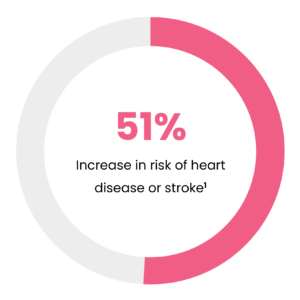
51% increase in risk of heart disease or stroke1
14X increase in cardiovascular event-specific death2

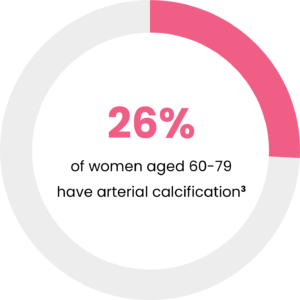
26% of women aged 60-79 have arterial calcification3
1 American Heart Association - Mammograms may provide clues about women’s risk forcardiovascular disease- Accessed May 15, 2025.
2 National Library of Medicine – Relationship between arterial calcification on mammograms and cardiovascular events - Accessed May 15, 2025.
3 National Library of Medicine – Relationship between arterial calcification on mammograms and cardiovascular events - Accessed May 15, 2025.
Key facts about Mammo with heart
- FDA-cleared AI-based detection software for identifying the presence of Breast Arterial Calcifications (BAC) in mammograms
- Works from your mammogram
- BACs are linked to an increased risk of heart disease and stroke, making detection crucial for patient health
- Determine if further evaluation is recommended
- No additional effort for you
- No additional radiation

Frequently Asked Questions
What is Mammo with heart?
Mammo with heart is an enhancement to traditional screening mammography that uses FDA-cleared, AI-based software – cmAngio® by CureMetrix® – to identify the presence of Breast Arterial Calcifications (BAC) on a mammogram.
Is this new screening FDA-approved?
Yes, the breast arterial calcification detection software that Onsite Women’s Health uses is FDA-cleared.
What is Breast Arterial Calcification (BAC)?
Breast Arterial Calcifications (BAC) is a calcium build-up in the arteries of the breast. The calcium deposition leads to arterial stiffening and increased pressure on the vessel walls. This is regularly observed on screening mammography.
Why does BAC identification matter?
Based on current research and published literature, Breast Arterial Calcifications (BAC) is currently considered to be a benign incidental finding without defined clinical importance to breast cancer screening. However, there is growing evidence that it is associated with other vascular calcifications and associated clinical outcomes. Patients identified with BAC may be candidates for additional clinical evaluation of general health.
How is it detected on my mammogram?
The cmAngio software reads your mammograms to determine the presence or absence of breast arterial calcification. An expert radiologist will review your results to confirm the findings.
Is an additional mammogram screening needed?
No, with cmAngio, a screening mammogram serves as a two-for-one exam with no additional screening and no additional radiation.
If I have BAC present, should I be concerned?
If you have a lot of breast arterial calcifications (BAC), it may not be immediately concerning on its own. However, it’s important to consider this in the broader context of your health. Factors such as age, medical history, family history of conditions like breast cancer or heart disease, as well as other risk factors like diabetes, high cholesterol, and blood pressure, should be considered. A comprehensive assessment that considers these factors is advisable to determine if further evaluation for arterial calcifications is needed.
How often should I get this assessment?
We recommend you repeat the screening every year with your annual mammogram.
I already see a cardiologist, do I still need BAC monitoring?
BAC screening is primarily used to identify patients at risk for cardiovascular disease who otherwise may not know that they are at risk. Patients currently under the care of a cardiologist should consider discussing this assessment with their doctor first. There’s no harm in having the BAC screening done, but benefits are still unknown for patients already being treated for cardiovascular disease.
Are there ages where this assessment makes sense? Am I too old or too young for Mammo with heart?
All women may benefit from a Mammo with heart assessment regardless of your age. Identifying risk factors for your health is important at any age.
Are there any patient populations for whom this service has not been established or validated?
Patients with breast implants or any other devices in the chest, such as pacemakers, should not opt-in for Mammo with heart.
Is it covered by insurance?
Mammo with heart is optional but is not yet covered by insurance. Therefore, any patient who opts in will pay out of pocket for the additional study. The current price at Wake Internal Medicine is $90.
How do I request Mammo with heart?
Contact our practice, or let the front desk know at check-in.